
Ethical Leadership Is a Boundary Practice
What do you think of when you hear the term "ethical leadership?" Today, it's easy to point to countless examples from the news: politicians making decisions inconsistent with their stated values; billionaires funding projects that will cause environmental harms; and leaders putting their incompetent friends into positions of power. But these actions are not just at the macro level. They happen every day in our personal and professional lives.
Imagine this: you discover that a coworker has been falsifying time sheets, or perhaps you’re asked by your supervisor to omit a critical piece of information in a client report. Maybe you've been asked to approve payment to a contractor whose work was questionable, or you found out that a member of leadership has been misappropriating funds by approving contracts with friends. Perhaps you overhear your supervisor making a racist comment about another member of your team. Or maybe you work for one of the many government agencies and non-profits that have had to cut their budgets for essential programs, let go of staff, or decline funding with conditions inconsistent with their organizational values.
These brief examples illustrate common ethical boundaries we may encounter at work, including:
Conflicts of interest
Misuse of resources
Dishonesty
Discrimination or harassment
Favoritism or nepotism
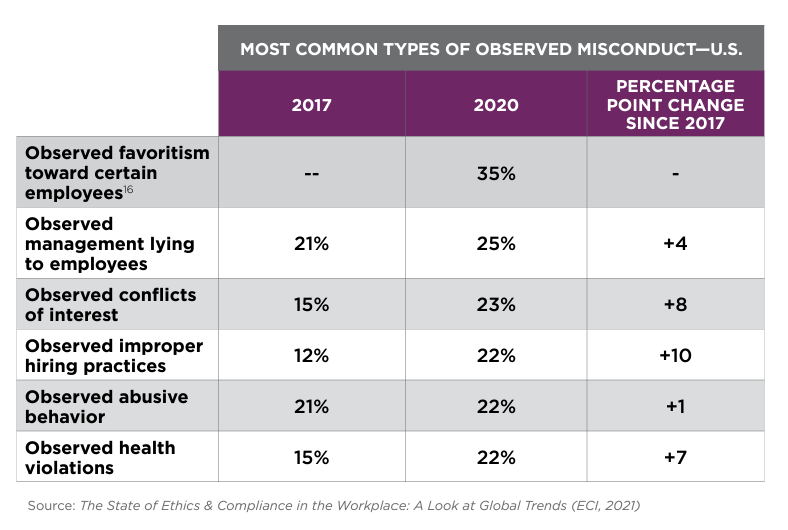
ECI, Most Common Types of Observed Misconduct—U.S." from The State of Ethics & Compliance in the Workplace: A Look at Global Trends (2021).
“Ethical leadership is the demonstration of normatively appropriate conduct through personal actions and interpersonal relationships, and the promotion of such conduct to followers through two-way communication, reinforcement, and decision-making.”
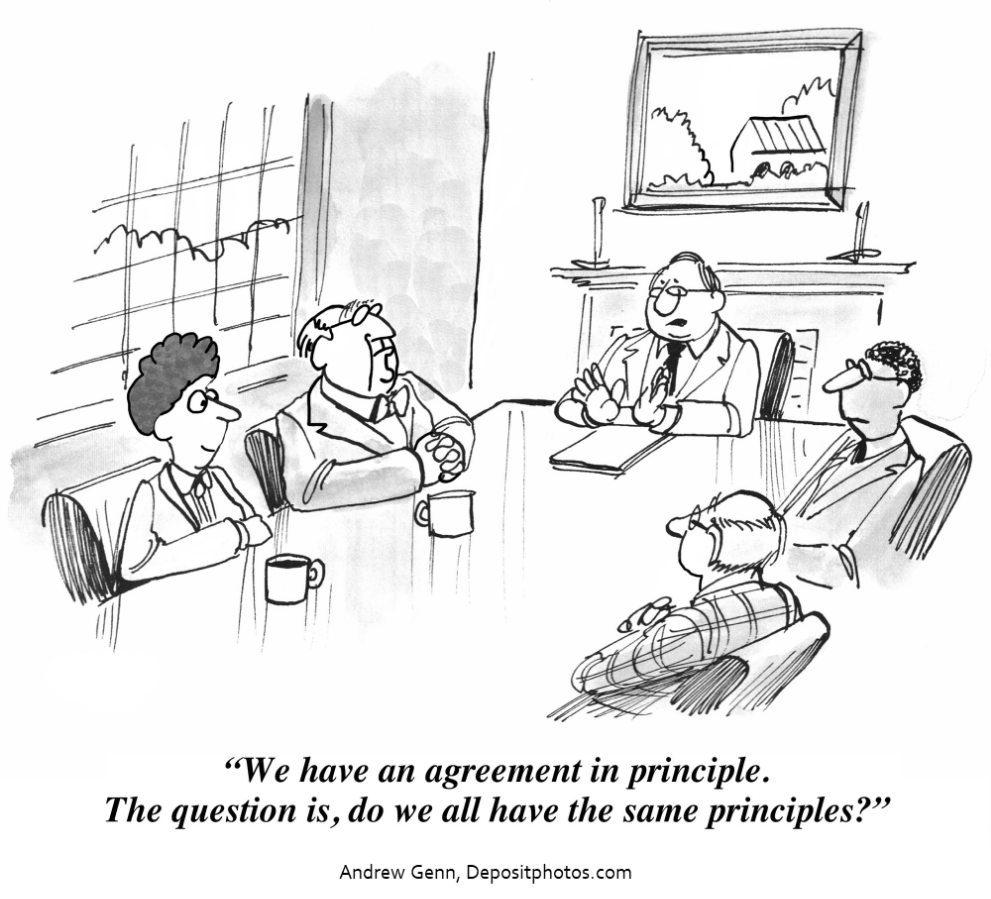
Leadership is about what you do. It's the behavior that you model to others that gives them permission to do the same. Ethical leadership is about leading with self-awareness and values as the foundation of your behavior. But as the opening comic suggests, we don't all value the same things and that is why relationships, particularly with people who don't share our opinions, are also a part of ethical leadership. Relationships are necessary to identify shared values and norms that guide individual and collective behavior.
Most decisions we make are not black-and-white. They live in a gray area that we navigate based on what we know, value, and believe and, if we do it well, in consideration and respect of what other people know, value, and believe. Ethical leadership depends on collective behavior. Our relationships influence our choices, who and what we support, and our willingness to say we're sorry when we get it wrong.
When I do ethical leadership training, I always start with values for two important reasons. The first is that knowing what we value helps us to make decisions that are aligned with who we are and to establish boundaries to protect what matters. The second is that we have to know where we stand because ethical leadership is tested when our personal values come into tension with external values.
It's in those moments that we have to consider:
what we want to do (based on our own values and beliefs),
what we should do (often determined by institutions, organizations, and communities),
what we are able to do or actually have the resources and capacity for,
and what we are allowed to do under the law.
So let's talk about what ethical leadership actually requires and why it matters.
📊 Data That Matters: The Trust Gap Is a Leadership Gap
Trust in leadership is thin. Only 23% of U.S. employees strongly agree that they trust their organization's leadership, but the ones who do are 61% more likely to stay. (Gallup, 2023)
Inconsistency is pushing workers out. 47% of workers say they've considered quitting because their employer's actions didn't match its stated values, and 36% say they've stayed quiet about unethical practices just to keep their job. (Resume Now, 2025).
Humans > AI. As more organizations automate HR and compliance functions, this is a good reminder that people still want a person when something goes wrong. The top four reporting options for ethical violations are all human-based: immediate managers, human resources, a manager's manager, or ethics & compliance. 60% of reports are made to a person. (Ethisphere, 2025)
The good news is that formal reports of misconduct rose nearly 5% in 2025, the highest sustained level on record (NAVEX, 2026). And yet, too many people remain silent.
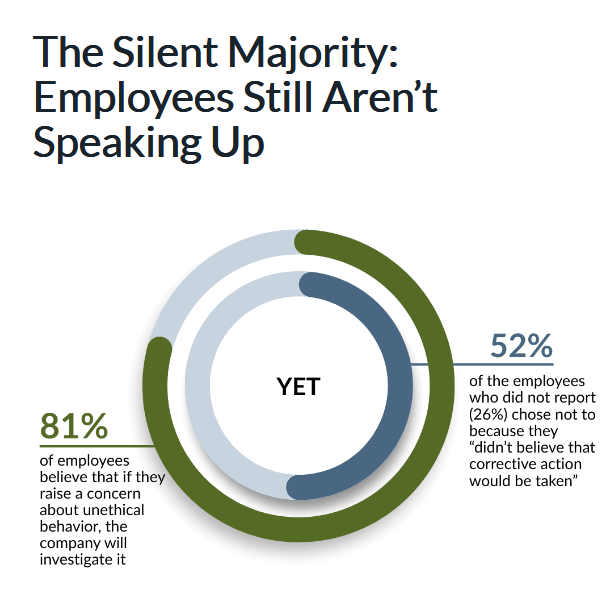
Ethisphere, 2025 Ethics & Compliance Report: Program Trends & Employee Perceptions
⚖️ Equity & Inclusion: There Is No Such Thing as Neutral
Staying quiet or taking a neutral position on decisions that affect marginalized employees is, in fact, taking a position.
The DEI rebrand undermines trust. 78% of C-suite leaders say they're renaming DEI efforts as employee engagement, belonging, workplace culture, or fairness, while claiming their commitment hasn't changed. But this just affirms that DEI efforts are lower on their list of commitments. Evidence? Only 62% of C-suite leaders say they are increasing or not changing their investments in DEI. (Catalyst, 2025)
Scaling back on DEI initiatives increases legal exposure for organizations. 64% of C-suite leaders and 62% of legal leaders say that there is an increased risk of discrimination claims from marginalized racial and ethnic groups, women, LGBTQ+ employees, and people with disabilities. (Catalyst, 2025)
Of course, this is where values come into play, because these same leaders are feeling real pressure from advocacy groups, social media campaigns, and consumers while navigating financial pressure from the federal government and private investors.
🔲 Boundary Highlight: There Are Lines You Don't Cross, Even If It Costs You
Is there a line you won't cross? For many of us, that answer is being tested right now and we are witnessing people in positions of power for whom no lines seem to exist. But ethical leadership is a boundary practice.
Sometimes leadership looks like refusal. Saying no to a shortcut. Asking for more information before making a decision. Turning down funding even when it's needed.
Honesty and transparency are part of a strong boundary practice. When decisions live in the gray area, being open about what choices are being made and why can increase acceptance and build trust.
True boundaries = accountability. After whistleblowers revealed that KPMG Australia had shared confidential information in a competitive bid, the firm lost its CEO, its head of audit, and government contracts worth hundreds of millions. Two years later, the firm is still working to rebuild what one crossed boundary cost it. (Ethisphere, 2026)
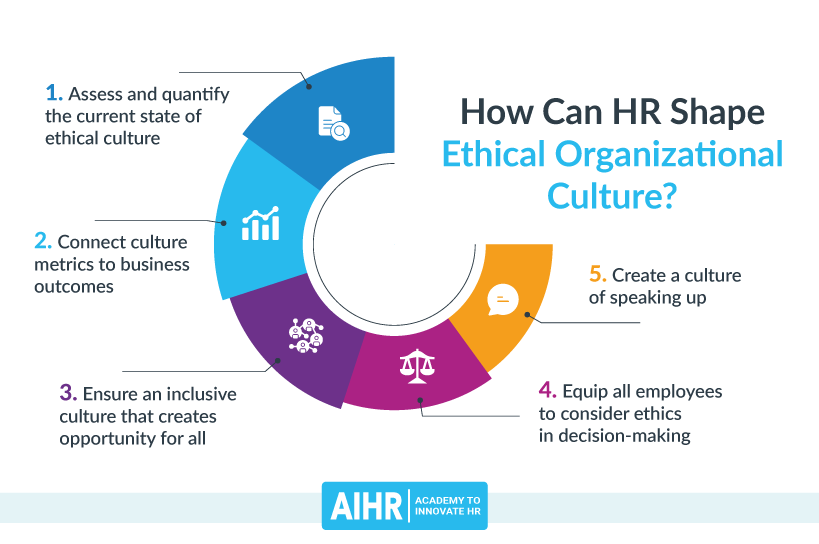
AIHR, How Can HR Shape Ethical Organizational Culture?
🧾 Law & Policy: You Have to Put Policy Into Practice
Building an ethical culture positively affects employee wellbeing by reducing emotional exhaustion and stress, increasing feelings of life satisfaction, and building psychological safety. (Peralta et al., 2023) It also strengthens engagement and retention, and can improve overall performance by up to 40%. (LRN Corporation, 2022)
Under OSHA’s General Duty Clause, employers have a general duty of care to protect employees from workplace hazards. While this has long applied to physical safety, in 2021, ISO 45003 set the standard for psychosocial hazards like burnout and harassment. Conducting risk assessments, acting on data and employee feedback, and creating a culture that supports physical, emotional, and psychological safety is part of meeting that duty of care.
Codes of ethics or professional conduct are an important tool to establish uniform standards within a profession or setting. However, they must be supported by policies and procedures with practical guidance on how to operationalize them. If you hold a license or certification, chances are you agreed to a code of ethics as part of your application process. When was the last time you read it?
✅ Actions You Can Take
🧠 Individual
Name your non-negotiables before they're tested. Decide in advance what your most important values are and be clear with yourself about what boundaries you will set to protect them. The Workplace Boundary Audit is built for exactly this kind of mapping.
Practice the pause. "Let me get back to you" is a boundary and a sign of thoughtful leadership. Slowing down a decision is one of the most accessible ethical moves for a leader.
Accept moral residue and find ways to manage what you're feeling. There are emotional consequences to our decisions, and accepting that up front can help you put practices in place to navigate them.
🏢 Organizational
Train managers for when people confide in them. Since most employees go to a human being first with reports of misconduct, it's important to train people on how to handle them.
Audit the gap between your stated values and actual decisions. What do your recent layoffs, promotions, investments, or cuts say about what you value? Use a structured audit tool to help identify your inconsistencies.
Protect people who speak up, visibly and specifically. Period.
🌍 Systemic
Establish an infrastructure for AI governance. Develop shared policies, oversight practices, and ethical guardrails that keep human values at the center of decision-making and address power imbalances in the development, access, and use of AI. (I wrote more about what this redesign asks of workplaces in July’s Brief).
Engage in collective advocacy. Partner with peer institutions, community organizations, and coalitions to address ethical issues and establish shared language, values, and practices.
Advocate for structural change. Use organizational influence to challenge policies, practices, and power structures that create or sustain inequitable outcomes.
Closing Thoughts
I share actions at the individual, organizational, and systems levels because I believe that meaningful and sustainable change happens when you address behaviors at all levels. It's hard to make ethical decisions when the leaders and organizations around you don't. But organizations are run by individuals and that's why it's important to address our own ethical standards, too.
If you want to learn more about where your boundaries stand or if you're leading a team and seeing the tension in real life, the Workplace Boundary Audit is a great place to start. And if you want a fuller picture of how your team or organization is doing on boundaries, ethics included, the Workplace Boundary Health Index is launching soon at dawnmhunter.com.
Leading with integrity is a practice built one boundary at a time. Where will you start?
Sources
Ethisphere, 2025 E&C Program Trends and Employee Perceptions Report
Catalyst, Risks of Retreat: The Enduring Inclusion Imperative (2025)
Ethisphere, The KPMG Australia Scandal: What It Really Costs When Leadership Fails
LRN Corporation, How Ethical Corporate Culture Impacts Employee Experience and Engagement
Peralta R, Simões E, Duarte AP. Subjective Well-Being in Organizations: Effects of Internal Ethical Context and Ethical Leadership. International Journal of Environmental Research and Public Health. 2023;20(5):4451.