
Older, Wiser, Pushed Out: The Real Cost of Ageism at Work
My mom has been a nurse for more than 45 years. I have so much respect for what she has accomplished in her career and the fact that she is still going strong. She says it gives her a sense of purpose and she loves helping people, and we know that having meaning and dignity at work are an important part of workplace mental health & wellbeing.
But what does it tell us about the workforce that my mom is working at 72 years old? Too much to get into today, but one thing that has stuck with me from recent conversations is that my mom says that she often sees managers give less bedside work or other duties because they don’t think older workers have the physical ability to do the job.
But it’s not just bias about physical ability; older workers face assumptions about their tech skills and responsiveness to change while also being passed over for training opportunities or not recognized for their expertise.
Experience is supposed to be an asset. When older workers leave, there are real consequences, not just in terms of institutional knowledge, but also in terms of generational diversity and collaboration.
This month, we're talking about age discrimination as a pattern that is costing workers their livelihoods, costing organizations their institutional wisdom, and costing all of us a more equitable workplace.
And this topic connects directly to what we talked about last month around AI and the future of work: the workers most likely to be disrupted by technological change are often the ones already being squeezed out for being too experienced, too expensive, or too 'set in their ways,' which, translated, usually just means too old.
You probably know someone living this right now. Maybe that someone is you.

My mom, Monica Hunter in her early nursing days. Yes, I have permission to share 🙂
📊 Data That Matters: The Numbers Don't Lie, They Just Make Us Uncomfortable
The data on age discrimination in the American workplace is trending in the wrong direction.
64% of workers age 50+ have experienced or witnessed age discrimination at work, according to AARP.
22% of workers 50+ say they feel actively pushed out of their current job because of their age.
EEOC age discrimination complaints hit 16,353 in FY2025, a steady increase since FY2022 (11,500 complaints). That's a whopping 42% increase.
The tech sector's over-40 share shrank from 55.9% in 2014 to 52.1% in 2022, falling below their representation in the overall U.S. workforce, all while several tech giants are facing age discrimination lawsuits.
Complaints about ageism during job searches jumped 133% in Q1 2025 compared to the same period the prior year, with workers in marketing and tech reporting the highest rates.
Note that Glassdoor’s report about the increases in searches for ageism places the burden on job seekers rather than employers, but the systems are what must change, not the workers.
Sources: Age Discrimination Holds Steady Among Older Workers in 2025 | EEOC FY2025 Enforcement Statistics | EEOC High-Tech Report | Glassdoor
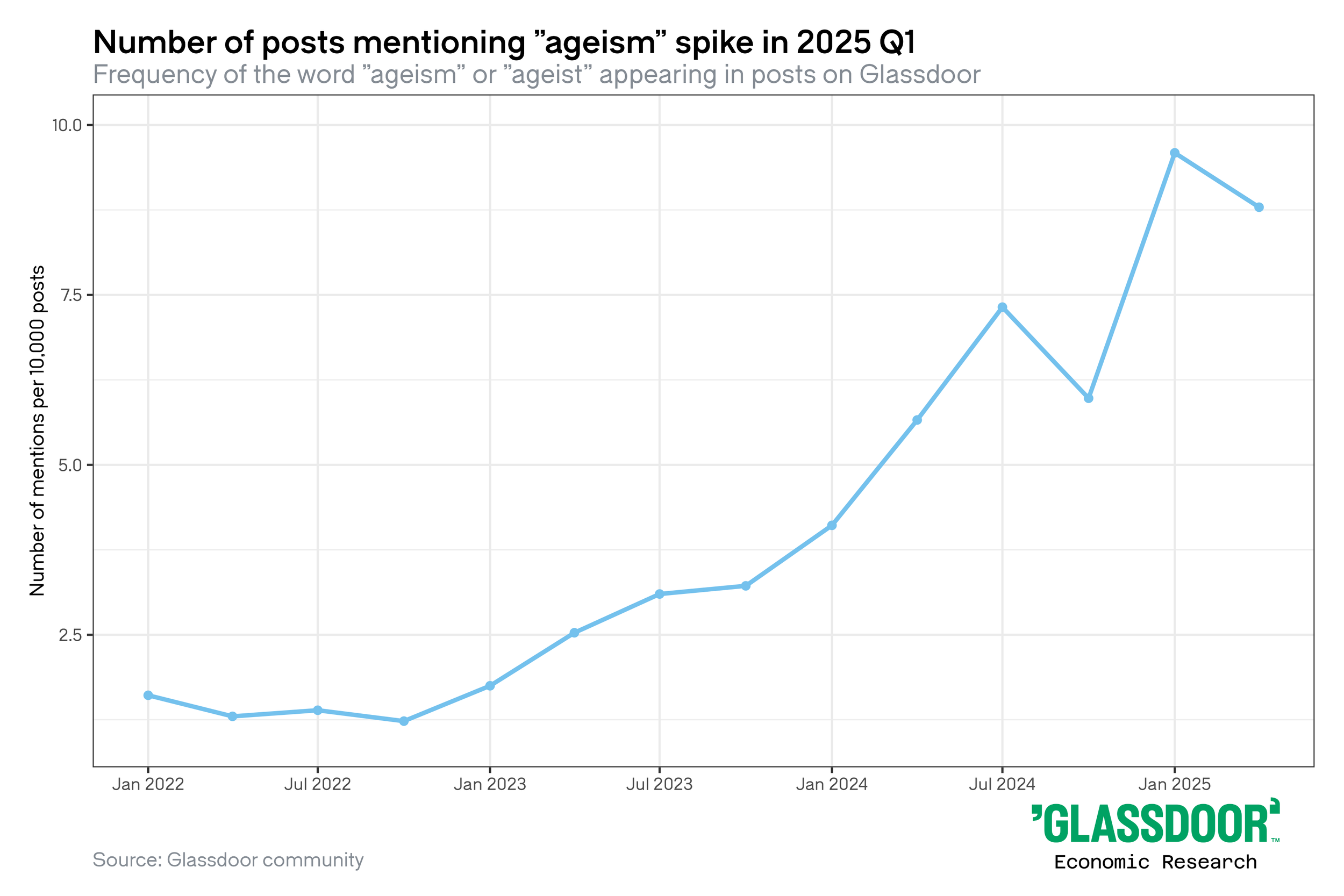
Source: Glassdoor
⚖️ Equity & Inclusion: When Age Meets Gender, Race, and Caregiving
Age discrimination doesn't hit everyone the same way. Intersectionality tells the whole story.
Women face a double penalty. Older women experience the compounding effects of ageism and sexism, or what researchers call 'gendered ageism.' We are passed over for promotions at younger ages than male peers, assumed to be less tech-capable, and replaced faster.
Black and brown workers experience higher rates of age discrimination. AARP's 2025 data show 71% of Black/African American workers over 50 report age discrimination, which is seven percentage points above the already-alarming overall average. The compounding of racial and age bias creates unique, often invisible barriers.
Caregiving is a hidden tax that mostly impacts women. Roughly 25% of women 55+ provide unpaid caregiving daily. A 2023 AARP study found 27% of working caregivers had to reduce their hours and 16% stopped working entirely due to caregiving demands. When they return, they face both an age penalty and a career-gap penalty.
Retirement insecurity compounds every other injustice. The gender pay gap over a lifetime means women reach retirement with smaller savings and Social Security benefits. In 2024, the gender pay gap was $0.83 for every $1 that men made, and women receive an average of 80% of the Social Security benefits that men receive.
Sources: Age Discrimination Holds Steady Among Older Workers in 2025 | NCOA Women & Aging Data | National Women's Law Center Social Security Report
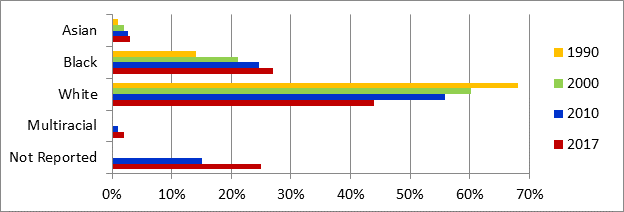
Source: EEOC, ADEA Charge by Race
🔲 Boundary Highlight: Financial Dignity and the Right to Stay
Age discrimination is a workplace boundary violation with direct financial consequences.
Financial boundaries start with knowing your worth. Know your market value, document your contributions, and keep that documentation current.
You have the right to name what's happening. Notice the patterns: a reduction in duties, being excluded from meetings or removed from projects, getting feedback about being 'overqualified,' or being skipped for training others receive. Workers who can name them clearly are better positioned to document and address them. Silence normalizes it for everyone.
Dignity at work is non-negotiable at any age. If you're over 50 and job searching, you deserve a process that doesn't filter you out before you walk in the door. Know that you’re not alone. There are several major lawsuits challenging age and other forms of discrimination in AI-powered screening and hiring tools.
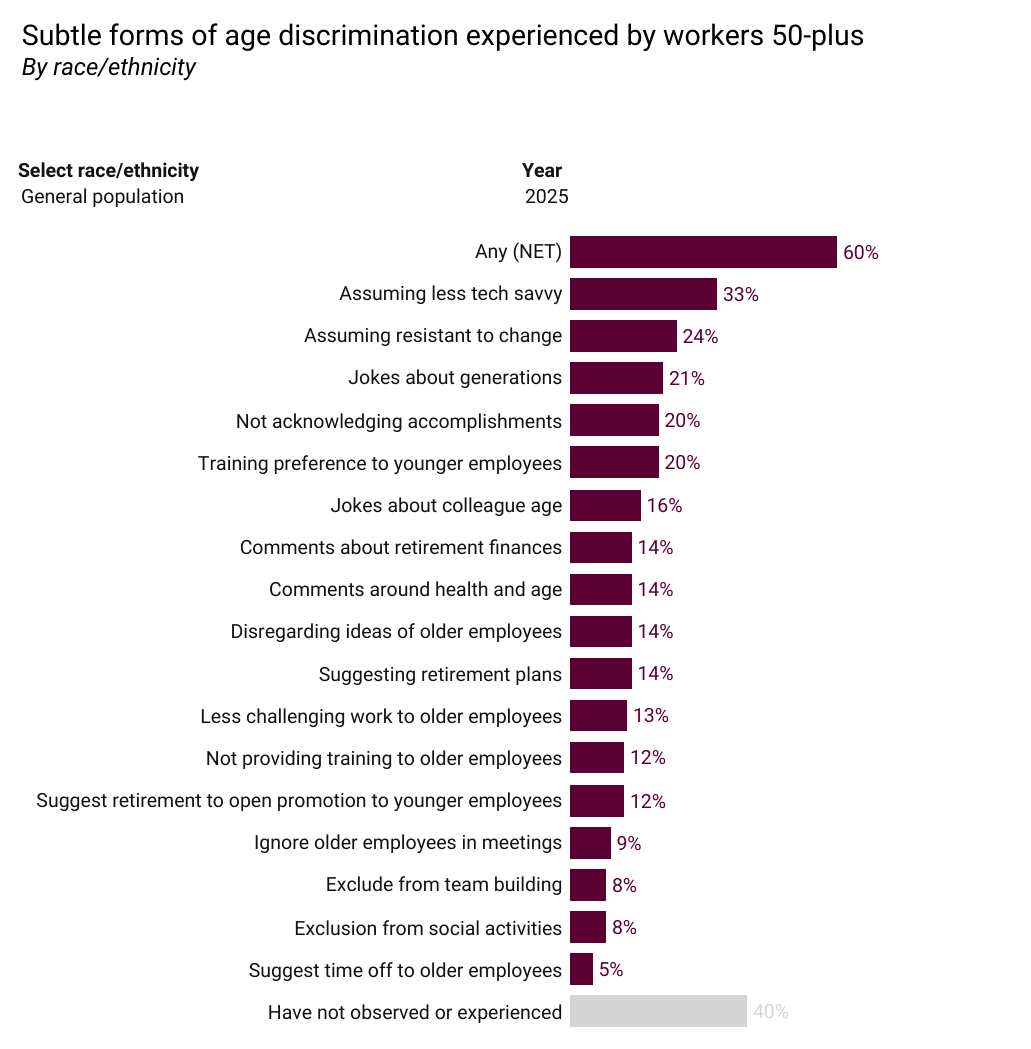
Source: AARP
🧾 Law & Policy: What the ADEA Does (and Doesn't) Protect
The Age Discrimination in Employment Act (ADEA) was enacted in 1967. More than 50 years later, it still has some serious gaps.
What the ADEA covers. Workers 40 and older at companies with 20+ employees are protected from age-based discrimination in hiring, firing, pay, promotions, layoffs, training, and benefits.
Age discrimination is harder to prove. Unlike Title VII (which covers race and sex), the ADEA requires workers to prove age was the determining rather than a motivating factor in an adverse employment action. This standard, set in Gross v. FBL Financial Services (2009), makes age discrimination cases significantly harder to win.
AI is the new frontier. In 2025, a California federal court certified an age discrimination class action against Workday, whose AI hiring tool allegedly filtered out applicants over 40. Although Workday asserts that human oversight is part of the process, it’s hard to envision how that works when people are screened out before a human interacts with them.
Sources: EEOC Fact Sheet: Age Discrimination | AARP Fighting Age Discrimination in the Courts |Federal News Network, 'Despite laws intended to prevent it, age discrimination abounds in 2025' | SHRM The Workday AI Lawsuit Is a Wake-Up Call for HR
✅ Actions You Can Take
🧠 Individual
Document everything. Write it down your experiences and include dates, specifics, and context. Documentation is the foundation of any complaint or legal claim.
Know your ADEA rights before you need them. Visit eeoc.gov to understand what's protected and how to file a charge.
Reach out to your network. It’s hard out there for job seekers right now. Actively engage with people in your network to get warm connections and insider tips on opportunities.
🏢 Organizational
Audit your turnover data. If your organization has gone through reductions in force, disaggregate the data by age. Who was let go? What was the average age at departure versus the overall workforce? Patterns create legal exposure.
Remove age-proximate language from job postings and the interview process. Terms like 'digital native,' 'recent graduate,' or 'young and hungry' can screen out older workers and may constitute ADEA violations. Have HR conduct a language audit.
Create equitable access to training and development. If AI tools, professional development, or stretch assignments are flowing primarily to younger employees, that could be a problem. Equity in opportunity is legal protection and good business.
🌍 Systemic
Advocate for ADEA reform. Contact your Congressional representatives in support of legislation that would bring ADEA protections in line with Title VII, and specifically a lower burden of proof and the addition of compensatory and punitive damages.
Push for AI hiring tool transparency and accountability. Support state and federal legislation requiring employers to audit algorithmic hiring tools for age, race, gender, and disability bias before deployment.
Challenge 'culture fit' as a hiring standard. When culture fit is used to pass over experienced candidates, it's often age discrimination with better PR. Push HR professionals and hiring managers to rely on criteria that are competency-based, not vibes-based.
💭 Closing Thoughts
We have built entire careers and entire industries on the promise that if you work hard and stay committed, your experience will be valued. And then we turn around and treat decades of knowledge like a liability.
Age discrimination is a workplace boundary violation at scale. It says that your worth has an expiration date. This is a core values problem, and one that can only be corrected by intentionally designing a workplace that supports all people to engage, no matter what they bring to the table.
Interested in how to design a more inclusive workplace? Let's connect.