
AI Isn’t Replacing Work. It’s Redesigning It. And most workplaces aren’t ready.
How have you been using AI in your professional life?
Here are few ways I've been using AI tools:
Creating outlines from a random jumble of ideas
Building organized project management workflows (💞love my Airtable integration)
Triaging email (if you know me, you know the volume of email I get is unreal at times)
Suggesting better ways to time block my calendar
These are just a few examples, and I don't expect AI to do the heavy lifting on anything. There is only one "me" and my perspective and style is unique. And the important thing is that this is true for all of us.
AI is everywhere right now. In our inboxes, our hiring pipelines, our meeting notes, our performance reviews. And if you’re in a leadership role, in HR, or just someone trying to figure out where you stand, the conversation is coming for you whether you’ve opted in or not. Many employees fear losing their jobs to AI, but I would argue that jobs are shifting, not being lost.
One thing that can't be replaced is genuine human connection and experience. The loss of institutional knowledge by eliminating employees isn't just about policies and procedures; it's about the culture and how values show up in day-to-day behaviors and interactions.
So let’s talk about it, with the understanding that how you engage with AI is, ultimately, a values question.
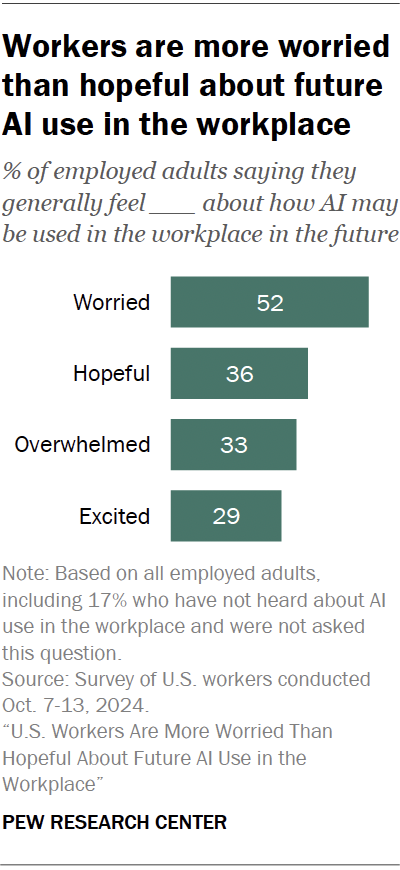
Where are you on this spectrum? I think I'm squarely in the "hopeful" category.
📊 Data That Matters: What's the Real Impact?
Let’s start with what the projections are actually saying, because “AI is taking jobs” is both partially true and significantly more complicated than the headlines suggest:
57% of U.S. work hours could theoretically be automated by today’s existing technology — not 57% of jobs, but the tasks within them. (McKinsey)
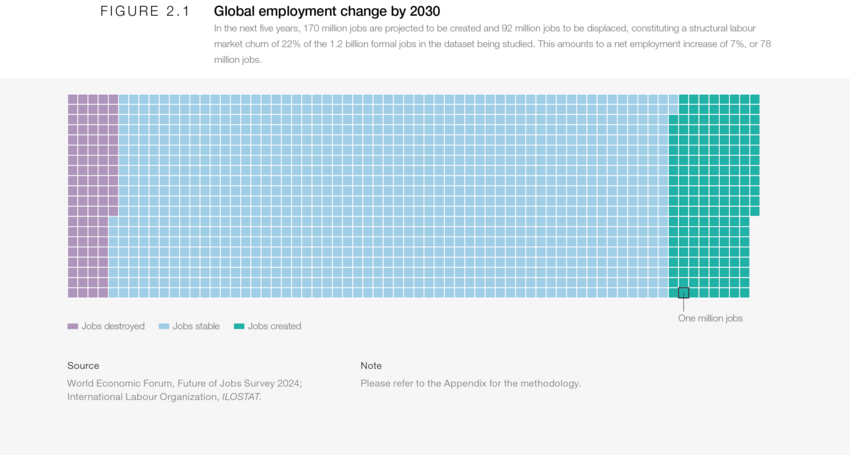
170 million new roles are projected to emerge by 2030, while 92 million are displaced — a net gain of 78 million jobs. (WEF Future of Jobs Report 2025) - see Figure 2.1 below.
16,000 U.S. jobs per month are currently being cut due to AI-related displacement, with Gen Z absorbing a disproportionate share. (Goldman Sachs, April 2026)
But here’s what the projections miss: the fear.
7 in 10 workers believe AI will cause layoffs at their company within three years.
Nearly half fear losing their own job to AI.
Only 1 in 3 workers say their employer is actually preparing them for what’s next, a drop of nearly 10 percentage points in a single year. (Jobs for the Future, 2026)
Expected global employment change. The total number of jobs expected to be created and displaced due to labour-market transformation relative to total employment today.
⚖️ Equity & Inclusion: Everyone Isn't Starting from the Same Place
If AI is redesigning work, we have to ask: whose work is being redesigned first? The answer has a pattern:
Lower-wage, predictable roles, including administrative, entry-level, clerical positions, face the steepest automation risk. These roles are disproportionately held by Black and Brown workers, women, and people without four-year degrees.
38% of workers of color report planning to change their career pathway due to AI (vs. 23% of all workers). 44% say they need new skills within the next year (vs. 29% overall).
The access gap is real. Organizations deploying premium AI tools for knowledge workers while leaving frontline and hourly staff behind aren’t just making a technology decision, they making a statement about who they value.
DEI rollbacks in 2025 have already narrowed the pipeline of institutional support right when the need is growing. AI adoption without equity guardrails will widen the gap.
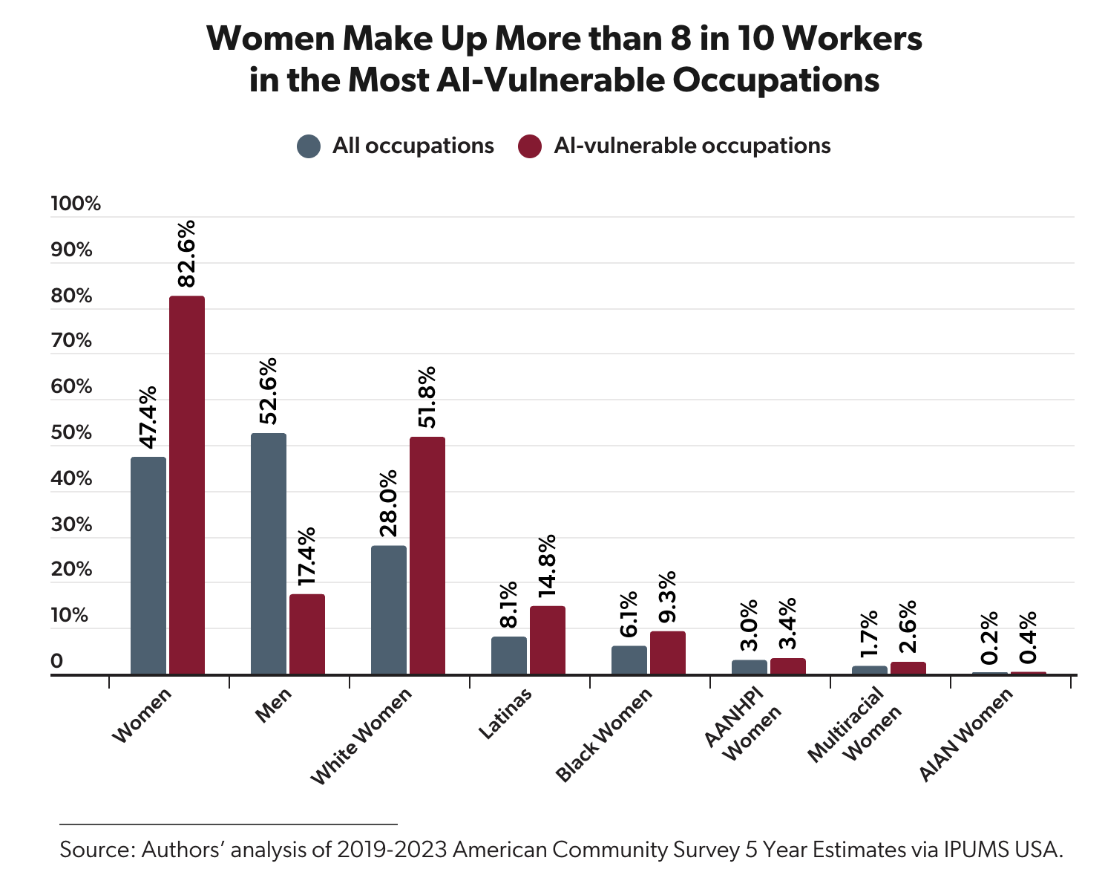
National Partnership for Women & Families
🔲 Boundary Highlight: The Mental Load Nobody Warned You About
AI was supposed to reduce cognitive load. In many cases, it’s increasing it. Here’s what the research is showing:
“AI brain fry” is real. A 2026 study highlighted by Harvard Business Review identified a pattern of mental fog, slower decision-making, and exhaustion that comes specifically from managing multiple AI tools and validating their outputs. We’ve traded one kind of work for another.
1 in 4 employees say AI has worsened their mental health due to information overload. (Spring Health, 2026)
“Accelerated burnout” is emerging as a real phenomenon. This is the idea of burnout developing more quickly as AI compresses decision timelines and eliminates recovery margins.
It's critical to put in place individual and organizational guardrails to prevent the negative effects of AI on mental health and wellbeing. But in many organizations, the rules are still being written
🧾 Law & Policy: The Rules Are Still Being Written, And That’s a Problem
The governance landscape is fragmented and moving fast.
Only 31% of companies have comprehensive AI policies, even as AI use accelerates rapidly. This lack of governance creates more risk.
The EU AI Act (in effect August 2024) is the most comprehensive global framework for AI in employment. AI used in hiring, performance evaluation, and employment decisions is classified as “high risk,” triggering requirements for: worker notification, human oversight, bias monitoring, and activity logging. Key employer provisions take effect August 2026 (a proposed deferral to December 2027 is not yet finalized).
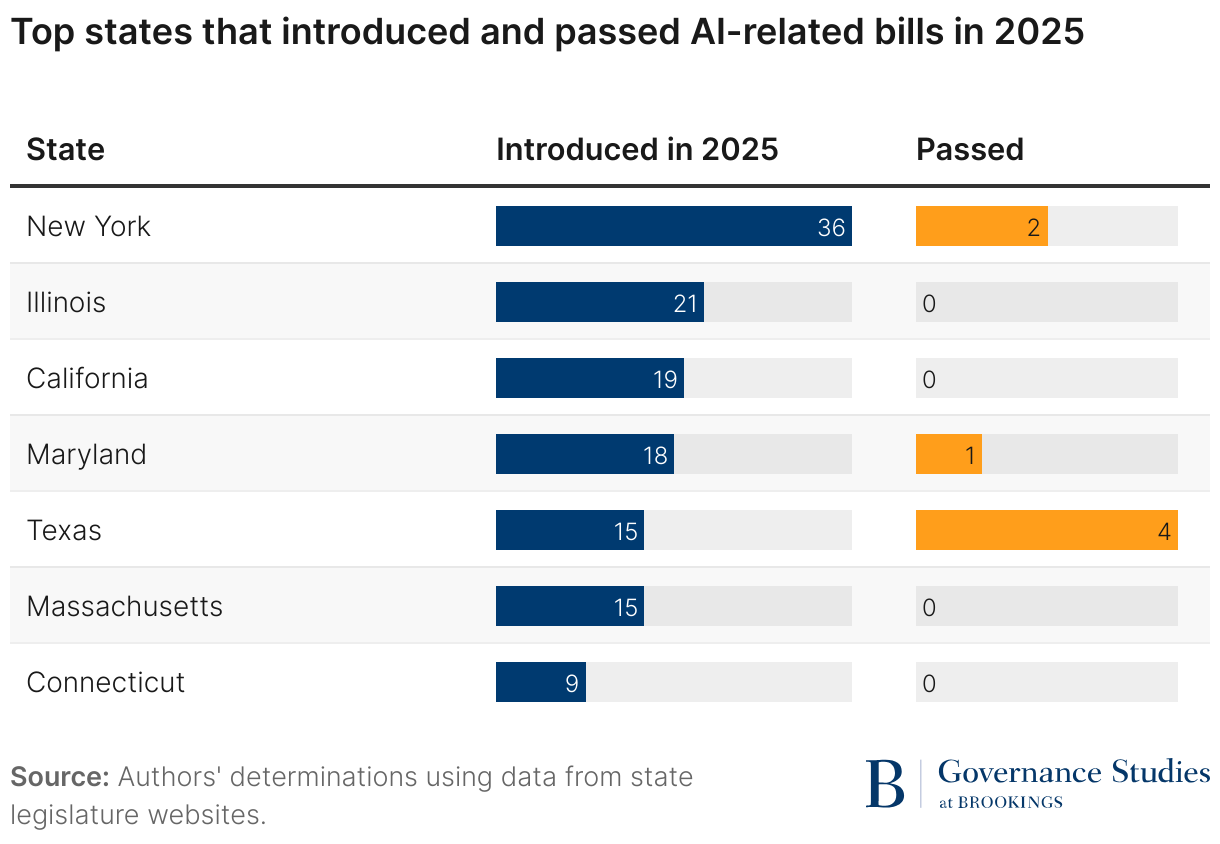
In the U.S., federal AI employment regulation is fragmented. New York, Illinois, and Connecticut have enacted transparency laws for AI in hiring, but there’s no federal equivalent. Most American workers have limited legal protection.
There are also several U.S. states that have introduced bills setting boundaries on the use of Automated decision-making technology (ADMT)/High-risk AI. Colorado's Consumer Protections for Artificial Intelligence Act aims to fight algorithmic bias and mitigate inequality. (Brookings).
We can also take a public health approach to AI-driven inequality by enacting laws and policies that address the root causes. This includes laws aimed at decreasing the racial gaps in educational attainment and apprecenticeship, policies outlining the ethical use of AI, and laws that build equitable technology infrastructure.
✅ Actions You Can Take
🧠Individual
Do a personal AI audit. Which tools are you using? Do they align with your values? Does any of it make you feel uncomfortable?
Talk to people and seek out different perspectives before you form your verdict. Ask colleagues, mentors, people in different industries, and people whose jobs look nothing like yours. Arrive at your own truth.
Protect your cognitive margins. Not every task needs AI. Deliberately leaving space for unassisted thinking, writing, and deciding is a mental boundary practice that will serve your clarity long-term.
🏢Organizational
Build AI governance before you need it. Your policy should cover permitted and prohibited use cases (especially in evaluation and hiring), data privacy, employee notification, bias monitoring, and accountability.
Train ALL your people. AI literacy cannot be limited to knowledge workers or leadership. Frontline and hourly staff need access to tools and training, too. Equitable AI upskilling is a retention and culture decision.
Mandate the human layer. High-stakes decisions like hiring, promotions, performance management, and discipline require human oversight. Build that requirement explicitly into your AI policy, in writing.
🌍Systemic
Advocate for federal AI employment protections. Contact your federal representatives about the need for clear standards on algorithmic bias, AI-based worker surveillance, and transparency in employment AI systems. BUT this legislation should be a floor, and not a ceiling on what states can do.
Support environmental accountability for the tech industry. Support legislation requiring energy and water disclosure from AI companies. Factor corporate sustainability into your vendor and tool selections.
Challenge the narrative that speed equals productivity. The expectation to produce more, faster, because AI theoretically can is a design choice, and one that's not based on the data behind performance. Advocate for performance systems that measure outcomes and impact, not volume.
Closing Thought
I spend a lot of time advocating for values-based leadership, because this helps us lead with empathy and make decisions from the individual level to the systemic that are more equitable and inclusive.
AI doesn’t have values. It doesn’t know what matters to you about your work, your relationships, or your sense of purpose. You bring that. The algorithm doesn’t.
In the last edition of this blog, I wrote about the loneliness epidemic at work and about how the erosion of human connection is one of the most underrated crises in modern workplace culture. AI has the potential to accelerate that erosion if we let it quietly replace the moments that make work feel human: the spontaneous conversation, the hard question asked out loud, the colleague who notices you’re off and says something, or the leader who turns into a mentor. These human interactions are the architecture of belonging.
People who prioritize connection, who lead with care, and who can hold the complexity of other human beings are the future of work, and what they offer isn’t automatable.
So find your footing with AI on your own terms. Use it where it genuinely serves you. Otherwise, set a boundary around it. Talk to the people around you about how they’re experiencing it. Stay in your values.
❓📊Not sure where your workplace boundaries are being pushed? The Workplace Boundary Audit is a good place to get honest.
Sources
• Goldman Sachs: How Will AI Affect the Global Workforce?
• Fortune: AI is cutting 16,000 U.S. jobs a month — Goldman Sachs
• Jobs for the Future: Worker Anxiety Over AI Is Growing
• Federal Reserve Bank of Chicago: Jobs for the Future: Worker Anxiety Over AI Is Growing
• National Partnership for Women & Families: New Analysis: More Than 30 Percent of Workers in the Most AI-Vulnerable Jobs Are Women of Color
• BusinessWire: U.S. Workforce in Mental Health Crisis Driven by AI Anxiety
• HRD Connect: Is AI Helping Burnout or Quietly Making It Worse?
• Help Net Security: More AI tools, more burnout (Harvard Business Review research)
• Spring Health: The Hidden Cost of AI Anxiety
• SHRM: AI Use and Remote Work Have Links to Loneliness
• Brookings: AI’s impact on income inequality in the US
• Brookings: How Different States are Approaching AI
• PBS NewsHour: Energy, water use and pollution of AI and data centers rival most countries
• EU AI Act: Regulatory Framework for AI